The History of Hosyers Almshouses and Charles Foxe Almshouses was compiled by David Lloyd MBE.

Dr David Lloyd MBE died in May 2019 was founder of the Ludlow Historical Research Group in 1976 and was also its chairman for many years and has written many books about Ludlow.


The Palmers Guild of Ludlow

Hosyer’s Almshouses were founded by John Hosyer, a wealthy Ludlow merchant, who purchased the present site on 22 April 1462. But the early history of the foundation is closely linked with that of the Palmers Guild, a local religious guild the origins of which go back to the mid-13th century.

The Palmers Guild began as a mutual benefit society, one of the purposes of which was to provide relief to members reduced to poverty. Assistance was to be given during sickness, with particular care to lepers and the blind. Priests were employed to say masses on behalf of members, both before and after death, and in due course the religious functions of the Guild were predominant. The Guild was dedicated to St Mary and later to St John the Evangelist also; and the word 'Palmer' was synonymous with pilgrim, as pilgrims to the Holy Land brought back palm branches as a proof of their journey. Not all Guild members went on geographical pilgrimages but they all aspired to a spiritual pilgrimage, which is why the title Palmers Guild became popular.

The Guild expanded greatly in the late 14th and in the 15th centuries. It owned a great deal of property, both in Ludlow itself and in the surrounding parishes, and in some more distant places, e.g. at Marlborough in Wiltshire. Members came from all over the Midlands, the west of England and Wales and from London, including members of the court. In 1394 the Guild 'built a new College for its priests on a site immediately north of that later occupied by the Almshouses. The name College Street is a permanent reminder of the building, substantial parts of which survive in College Court and in No. 2 College Street.

The Guild performed many good works in Ludlow. Their priests were closely involved in the running of the parish church. They provided its first organ and paid the salaries of the organist and choristers. From the early 15th century or earlier the Guild was responsible for the Grammar School and a Guild priest served as Schoolmaster. When John Hosyer, himself a Guild member, was mindful to endow a charitable institution, it was therefore natural that he should choose a cause consistent with the Guild's purposes, and that he should lodge the administration of his endowment in the hands of the Guild's Council.

Hosyers Almshouses under the Palmers Guild

John Hosyer purchased the site for the almshouses on 22 April 1462. A large rectangular plot, this was one of the burgages opening to the original High Street or market place. It was laid out in the town's first phase of development, probably in the late 11th or early 12th centuries. Like other burgages in this part of Ludlow, the frontage width was exactly three perches, i.e. 49 feet, the perch (16% feet) being the standard unit of measurement in medieval town plans. The side of the present building, onto what is now Church Street, retains this width, an evocative link with the early Norman surveyors.

By the 5th century this prime site was owned by John Wolfe, a Ludlow merchant. On his death it passed to his daughter Joan and her husband, John Eye of Eye, a parish a few miles south of Ludlow. It was from John Eye that Hosyer made his purchase. His will instructs his executors to “complete the building of the almshouse begun by me by the church . . . with all possible haste’, soil can be assumed that work had started sometime between the purchase 22 April 1462 and the making of John Hosyer's will on 3 June 1463.

It is not known when the building work was finished but it was certainly before 8 December 1486, when a final settlement of the endowment was signed by the two surviving trustees and by the town’s bailiffs. This charter is an important document, for it provided the articles of government for the next 65 years — and influenced the way that the Charity was administered in later periods.

The charter specified land: from John Hosyer’s estates which had been conveyed to the Palmers Guild by his executors. These were in Ludlow itself, Hopton Wafers, Cleobury North and Stanton Lacy. They yielded rents of £9 13s 4d a year. The Guild was also given a silver cup and a capital sum together worth £20. In return, the Guild had lo mainland the almshouses and support 33 inmates, each of whom had a heated chamber. One of those was appointed bellman. He was to receive 2s. a year, For which his duty was to summon the inmates to prayer in the almshouse chapel twice daily - at 8 a.m. and 5 p.m. The trustees also made elaborate arrangements for commemorative masses to be said for Hosyer and his family at the Chantry chapel of the Holy Trinity. This was just inside the west door of the parish church, on the north side. The priest serving this chantry had a chamber in the almshouses, giving a total of 34 rooms.

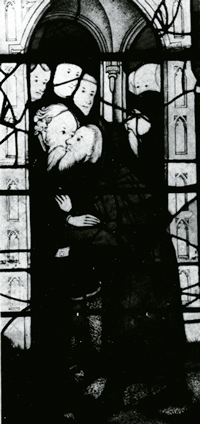
Members of the Ludlow Palmer's Guild in the late Middle Ages, as portrayed in a window in St John's Chapel in the parish church. They are greeting two Palmers who had been successful in obtaining a royal charter for the guild.

The inmates of the Almshouses were to be Guild members. For admission, members paid a substantial fine - 6s 8d or 13s 4d for a married couple. Such a figure meant that the poorest members of Ludlow society could never have attained Guild membership and would therefore not be eligible for residence at Hosyer‘s almshouse. Those who were admitted must have been people whose income and therefore social status had fallen, due to commercial misfortune, infirmity or, most commonly, widowhood.

No picture or detailed description survives of the first almshouse but a reasonable reconstruction can be made. References to the east and west ranges and to upper and lower chambers suggest that it was U shaped, with an open side onto what is now Church Street but which was then called Almshouse Lane. This is a not uncommon form for medieval communal buildings, utilising the long narrow shape of medieval burgages. The 34 chambers perhaps made up two ranges of 14 chambers each, i.e. seven on each floor, with six more facing the entrance, with three on each floor. Every room was heated, so there would have been many chimney stacks. The building material was probably sandstone, large blocks of which were retained as a foundation when the present building was erected in 1758.

In late medieval Ludlow this must have been a large and striking building, situated as it was on a prominent site next to the parish church. The almshouses certainly caught the eye of John Leland, the Tudor topographer, when he visited Ludlow about 1540. He wrote:

There was a very rich merchant in Ludlowe not long synce called Hosier, buried in the parish church, who founded a cantarie... endowing it with 10. or 12. £ land be the yeare.

Hosyers Almshouses under Ludlow Borough Corporation

Following the Chantry Acts of 1545 and 1547, the Palmers Guild of Ludlow was dissolved in 1551. Within a year, however, negotiations between Crown Commissioners and Ludlow Borough Corporation resulted in the estates of the Guild being transferred to the Borough, in return for the Borough assuming responsibilities for the Guild charities. These included Hosyer's Almshouses.

The transfer is specified in Clause VII of the The Charter of King Edward VI to the Town of Ludlow, dated 26 April 1552. This states: The same bailiffs, burgesses and commonalty of our town or borough . . . shall keep and maintain . . . with the issues and profits of the said messuages, and of the other premises . . . belonging to the said guild . . . thirty three poor indigent persons within the said town or borough of Ludlow, giving or paying to every one of them four pence every week annually, and also one chamber for every of them to live in, to be continued for ever. . . .

This is why, in the 19th century, the almshouses were classified, with the Grammar School and the support of assistant clergy, as one of King Edward's VI charities, even though their foundation is nearly a century earlier than the 1552 charter.

The increasing number of the poor was a persistent social problem under the Tudors, in Ludlow and elsewhere. Understandably, Ludlow Borough Corporation made use of their newly acquired almshouse to ease the situation. Regulations drawn up in 1591 restricted admission to the aged and impotent poor who had spent their youth in the town, though in 1593 it was agreed that this should be waived in certain cases. Inmates were forbidden to receive lodgers and the almshouse doors were ordered to be locked at 9 p.m. and opened at 6 a.m. General inspections of the almshouses to remove children and other intruders and to check the qualifications of the inmates were ordered from time to time, e.g. in 1594 and 1694.

By 1580 a chaplain was being employed to say morning prayers in the almshouses. By the 18th century it was customary for one or both of the town beadles to be granted a chamber there. The head beadle came to perform the functions previously exercised by the bellman. He was also responsible for distributing payments to inmates.

The maintenance of the building was a continuing expense for the Corporation, but from 1732 onwards there were persistent complaints that residents were in 'manifest danger of their lives' due to the collapse of the timber-framed partitions and the poor condition of the floors. In the 1750's, therefore, it was decided to rebuild the Almshouses, as part of the prog-ramme of improving public buildings which began with the new Butter Cross in the mid 1740's and finished with the remodelling of the Guildhall in 1768.

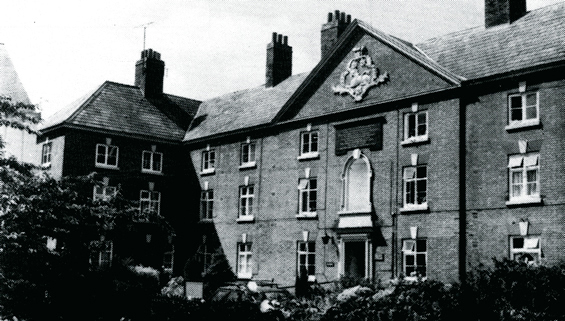
In 1756 William Baker, architect of the Butter Cross, was asked to pro-vide a plan for the Almshouses, but this came to nothing, perhaps because his costs were too high. Two years later it was agreed that Thomas Farnolls Pritchard (1723-77) of Shrewsbury would design the new building, the first of several major works by him in Ludlow, including the Guildhall. The new building, largely made of local brick, still had 33 chambers — 11 on each of the three floors — but the plan was now a broad U shape opening eastwards towards the parish church. To provide a prestige entrance, the three central bays of this eastern front are set forward and are surmounted by a pediment containing a large cartouche with the Ludlow arms.
In addition to their accommodation, food and heating, the inmates received 4d a week until 1716, when the amount doubled. There were further increases, giving a total of 2s 6d in the early 19th century. After the new building had been erected, the Corporation resolved that a bedstead and 'three or four' shelves should be provided in each room, but inmates could provide additional furniture themselves. Toilet arrangements must have been meagre, for inmates were often presented to the local courts for emptying their chamber pots in the churchyard!

Lists of residents can be drawn up for various years, the example for 1763, as shown opposite. In that year, as on other occasions, six of the 33 rooms were shared, by married couples or by a mother and daughter. Of the 21 cases where the former occupation is known — of the almsperson or of a deceased spouse — about half were labourers, but there is a wide spread of other trades. In the case of Richard Eaton, joiner, he had been a journeyman, working for a master craftsman, but Samuel .Griffiths, butcher, and Thomas Vaughan, shoemaker, are known to have had their own small businesses. The most dramatic case of social decline is that of Walthall Fenton, the nephew of a former Rector of Ludlow. For some years he had been landlord of The Crown, Ludlow's largest coaching inn, and in some documents, including the parish registers, he was at that time dignified by the prefix 'Mr'.

Surviving documents allow only occasional glimpses into the lives of the almsfolk. Many of them endured much poverty and hardship, before members of the Corporation picked them out from the great mass of Ludlow's poor, as worthy of the receipt of John Hosyer's charity. They had lived, for the most part, in the poorer parts of the town, such as Galdeford, Lower Broad Street and Raven Lane, where low quality back buildings were stretching out down the historic burgages. Several of the residents had had more than one spouse before coming to Hosyer's, notably Thomas Cleeton, who had three wives, all of whom pre-deceased him. Most of them had had children, and nearly all of those had experienced the pain of losing at least one child. Thus the two wives of Benjamin Carless bore him ten children, but four died in infancy. In at least one case, however, that of Henry Bannister, a resident married whilst at Hosyer's. His first wife, living with him at Hosyer's in 1763, died in 1774, but two years later he married again, and moved out of the almshouses for the last five years of his life!

Other charities benefiting the residents of Hosyers Almshouses between 1552 and 1835

Throughout this period, many better-off Ludlow residents gave generously to the poor. Between 1550 and 1600, for example, 65 of the 194 extant Ludlow wills had bequests to the poor. Most of these were one-off donations, but a few followed the example of John Hosyer and made endowments, that is gave property or invested funds in favour of a particular charity. A number of the charities were specifically for the residents of Hosyer's Almhouses. These included:

Thomas Candland, 1617

Thomas Candland was a prosperous Ludlow mercer, who had premises at Nos. 14/15 King Street. He was on the Corpo-ration for 45 years, and served as Bailiff six times. He left a rent charge from what is now No. 13 King Street to provide 4d to each resident at Hosyer's on Ash Wednesday.


James Walter, 1624

James Walter was the son of a Ludlow judge, Edmund Walter, Chief Justice of South Wales, whose tomb is in the chancel of the parish church. He acquired lands in Richards Castle and set himself up as a substantial landowner. He left £10 a year to Ludlow Borough Corporation which was used with other funds to increase the weekly payments to the Hosyer's residents.


William Archer, 1677

William Archer was a landowner who held office at the Council of the Marches which had its headquarters at Ludlow Castle. He left a rent charge from land in Sutton's Close (between Old Street, Friars' Walk and Lower Galdeford), from which the Hosyer's residents were given 4d each on Good Friday.


Susan Gay, 1724

Susan Gay left land at Kingsland, Herefordshire, the income from which was used to increase the weekly payments.
Morgan Lloyd, 1735. Morgan Lloyd was a carrier, who lived in Dinham. He gave a rent charge from No. 40 Dinham which gave the residents 4d each a year.


Mary Betenson, 1797; Susan Smith, 1801; and Sarah Owen, 1824

These ladies were all widows who left £100 each to further increase the weekly payments.

Charities benefiting the poor generally which were later associated with Hosyers Almshouses

Dr Charles Sonnibank, 1635

Dr Sonnibank was the son of a Ludlow goldsmith. He became an eminent scholar at Oxford and was later Dean of Windsor. He left land at Hopesay, ten miles north west of Ludlow, the rent of which provided 6d each Monday for ten poor widows.


Thomas Lane, 1671

Thomas Lane was Secretary to Sir John Charlton of Ludford House, one of the leading judges of his day. He left land off St John's Lane, the rent of which provided a loaf each Sunday for 12 poor persons. He also left funds to establish a workhouse.


Evan Phillips, 1674

Evan Phillips was an official at the Council of the Marches. He left land in Linney — later known as 'Poor's Close' — to provide money for 18 poor persons.


Richard Davies, 1699

Richard Davies was a Ludlow ironmonger, who was a prominent member of the Corporation. He left £100 to provide 15s a year. for 8 poor widows.


Eleanor Handford, 1706

Eleanor Handford was the widow of an official at the Council of the Marches. She left capital of £25, which yielded 2s 6d on Good Friday to each of 10 poor persons.


John Long, 1706

A Ludlow wine merchant, who left capital of £20 for the poor.


Emma Robinson, 1719

Emma Robinson was one of the daughters of Sir Job Charlton. She married John Robinson, Bishop of London. She left capital of £50, which provided 2s 6d. a year for 20 poor householders.


Thomas Meyrick, 1724

Thomas Meyrick was a Ludlow cloth manufacturer who left £40 to the Borough Corporation for loans to poor tradesmen.


Thomas Hollingsworth, 1809.

Thomas Hollingsworth left capital of £50 to provide Christmas bread for poor widows.

Charles Foxe Almshouses, 1593 - 1993

Charles Foxe (d. 1552), founder of the Almshouses in Corve Street which bear his name, was arguably the most powerful man in Ludlow in the second half of the 16th century. The second son of William Foxe of Ludford, who was Member of Parliament for Ludlow on several occasions, Charles was born into a world of influence and intrigue. Trained as a lawyer, he became Secretary to the Council of the Marches in 1558, at a time when that Council, after an uncertain start, was stamping its authority on Wales and the border counties. 'With the skill of a gifted pluralist', he obtained other Council posts for himself, including the Clerkship of the Council.

Foxe enjoyed a life style to match his position. Early in his career, he purchased the buildings and lands of the former Benedictine Priory at Bromfield, where he built himself a fine new house, incorporating the chancel of the parish church as a private chapel. Later he acquired the adjoining park — formerly used for hunting by the lords of Ludlow Castle — thus creating the future Oakly Park estate. He also constructed a grand town house around what was later known as Quality Square, a building fine enough to catch the eye of a visiting poet in 1587 who called it 'the fayre house of Maister Secretarie Foxe'.

As well as his own house, Charles Foxe bought several properties in Ludlow, including two in Corve Street. One of these (plots 117/118 on the 1825 map below) consisted of land which had previously belonged to the Knights Hospitaller of Dinmore. They had built a small chapel there in the late 12th century — and dedicated it to St Leonard. The other was land adjoining to the south (plots 115/116), which had previously belonged to the Carmelite Friary.

Like John Hosyer some 125 years later, Charles Foxe took no action to found the almshouses until late in his life, although the land had been in his possession for many years. In his will, dated 12 October 1590, he stated that he had begun to 'erect four almshouses for four poor and impotent persons'. He endowed the foundation with four houses and other property in Worcester and made careful provision for the spiritual well-being of the residents: divine service was to be read in St Leonard's Chapel at certain times each week, and a sermon was to be preached at Christmas and Lent. He also gave two bells to be hung in the steeple of the chapel.

Charles Foxe died a few weeks after completing his will and was buried at Bromfield on 21 December 1590. His executors — three of his sons and his brother Edward — confirmed the foundation of the almshouses in a scheme dated 2 April 1593. The residents were to be poor people from the parishes of Ludlow and Bromfield and should continue there for life, unless removed for misbehaviour. The curate of Ludford was appointed to read service in the chapel every Wednesday and Friday, and every Sunday and festival day in the year.

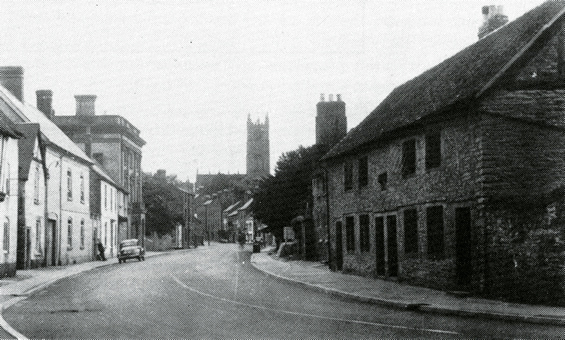
This photograph is from the Francis Frith collection, taken in the late 1940's, shows the Charles Foxe Almshouses on the right.

The almshouse building, begun in 1590 and completed before 1593, is of two storeys, each unit having one main room at each level, with a small kitchen to the rear. There are two large chimney stacks at the rear. The walls are of coursed rubble, and crude oak rafters support the ceilings. There was considerable restoration in the 19th century and the rear kitchens have been extended, but the general feel of the late Tudor building remains.

For the next 176 years the administration of the Almshouses remained in the hands of the Foxe family. For much of this period the trust was taken seriously, as in 1689 when Somerset Foxe of Caynham — previously a Colonel in Prince Rupert's Royalist army — left 20s. Yearly to the 'Hospital of St Leonard' and another 20s. To the Preacher of Ludlow for preaching three sermons in the chapel. But in the 18th century, when all local branches of the family had died out, the chapel, in particular, was neglected. This led to a local court ruling in 1757 that the tiling should be taken off the chapel because it was 'a great nuisance and very unsafe to passengers'.

In 1769 the last surviving trustee, James Foxe, who lived 'remote from the premises', asserted that he had continued to pay and maintain 'four poor women' in the almshouses. This is supported by surviving records which show, for example, that in 1763 the Foxe Almshouses were occupied by Widow Griffin, Widow Mire, Widow Hayward and Widow Powell. He acknowledged, however, that the chapel was 'in a decayed and ruinous state'. He agreed, therefore, to convey the lands and buildings of the foundation, including the properties at Worcester, to Ludlow Borough Corporation, subject to the original purposes of the charity.

For the next 68 years the Charles Foxe Charity was in the care of the Corporation. Throughout, they maintained the almshouses and supported the inmates, so in that regard they were true to the trust they had acquired. But their breach of trust with regard to the chapel became notorious, causing the Lord Chief Justice to remark that he had not expected to find 'such gross neglect of duty in a Christian country'. They began by allowing the chapel to be demolished in the 1770s, selling some of the materials and using others to repair Corve Bridge and for other public works. Then they issued a 99-year lease of the chapel site to Edward Acton, one of their members, and allowed him to build premises there for glove making — the present Nos. 38 and 39 Corve Street. These misappropriations were later used against the Corporation by radical reformers and resulted in an action in the Court of Chancery, but it was not until 1870 that the chapel was rebuilt on another site.

The Age of Reform: Appointment of Ludlow Municipal Charity Trustees

In the early 19th century concern was expressed in many parts of England and Wales about the way that charitable endowments were used. Commissioners were appointed in 1818 and visited Ludlow in 1820. They found many of the charities in good order, but on Charles Foxe's charity they felt there were points that 'deserve some explanation'.

The 1832 Reform Act had tremendous results for Ludlow and for its charities. It led to the Municipal Reform Act of 1835; which caused oligarchic Borough Corporations, like that at Ludlow, to be replaced by elected Borough Councils. The 1835 Act also insisted that charity and municipal property should be separated. Two years afterwards officers of the Lord High Chancellor visited Ludlow and appointed 17 Municipal Charity Trustees.

The trustees were responsible for what were called the King Edward the Sixth charities, that is all those derived from the Palmers Guild, which included Hosyer's Almshouses. They took over the Charles Foxe Almshouses. They were also responsible for a large number of other charities, including those listed on previous pages, to be known as the Ludlow Minor Charities. One trustee was Sir Edward Thomason, a Birmingham manufacturer who had retired to Ludlow. The rest were all Ludlow residents — nine of them tradesmen, the rest either annuitants or members of one of the professions.

Sadly, the division of the former Borough Corporation property between the new Borough Council and the Trustees proved difficult and acrimonious. This led to a protracted and expensive lawsuit, resulting in the enforced sale of a large proportion of the estate to cover legal charges. By a scheme of 1848 the Trustees were left with just over 1,000 acres of land and capital of some £6,000.

The Trustees introduced a number of changes in the administration of Hosyer's Almshouses. The 1848 Scheme required residents to have lived in Ludlow for at least ten years and to be of good repute. They received stipends of 7s. a week and every third year they were given dark blue coats or cloaks. Residents were expected to attend church daily but this does not seem to have been enforced. A warden and matron, usually a married couple, were regularly appointed after 1852. There was a major refurbishment in 1857, as testified by the dated rainheads which are still on the College Street front.

Following negotiations between the Trustees and the Charity Commissioners, a new scheme for the Charles Foxe Almshouses was introduced in 1863. The almspeople were to be poor persons, of either sex, who were to be not less than sixty years of age at the time of appointment. Three of them were to come from Ludlow and one from Bromfield. They too were to receive 7s. a week. The buildings were 'heavily restored', with new plank doors in moulded ashlar doorcases, and with a new coat of Foxe arms in the centre of the building.

The Replacement of the Ludlow Municipal Charity Trustees by the King Edward VI Charity Trustees and by the Foxes Charity Trustees

After only a few years of operation, it became clear that the responsibilities of the Ludlow Municipal Charity Trustees were too wide. Pressure for education reforms led in 1876 to the division of the estates between the Governors of Ludlow Grammar School on the one hand and the King Edward VI Charity Trustees and the Foxe's Charity Trustees on the other. The King Edward VI Charities and the Foxe Charity were kept separate for historical reasons and because of different patterns of land ownership but the Trustees were the same persons acting in different capacities.

Initially the King Edward VI Trustees had responsibility for all remaining charities except Foxe's Charity, but by a scheme of 1918 those relating specifically to the parish church were put under separate management. This left the King Edward VI Charity Trustees — still 17 in number — responsible for Hosyer's Almshouses and a host of minor charities, those listed opposite and on pages 12 and 13. Both the King Edward VI Trustees and the Foxe Trustees have employed a salaried clerk to administer their affairs. In both cases most of their assets have been transferred into invested capital, the interest from which meets their revenue and operational costs.

Charities bequeathed after 1837 and entrusted to the Ludlow Municipal Charity Trustees and their successors

Margaret Phillips, 1838

Margaret Phillips was a native of Ludlow, who later lived at Clifton, Bristol. She left £1,000 to `the Upper-almshouses' and £500 to 'the Lower-almshouses'. She left another £1,000 to endow a lying-in charity for expectant mothers in poor circumstances.


Thomas Bolfteld, 1843

Thomas Botfield was an iron master from Coalbrook-dale, who purchased the lordship of Hopton Wafers and set himself up as a land-owning country gentleman. He left money for the poor.


James Brettel Vaughan, 1848

James Brettel Vaughan was a landowner from Burway, in Bromfield parish, who lived at no. 14 Castle Street, Ludlow. He left E100 to provide Christmas bread for poor widows.


Emily Felton, 1871

Emily Felton was one of the daughters of William Felton, the Ludlow radical and printer. She left money for the poor.


Maria Nightingale, 1884

Maria Nightingale was a Ludlow resident who left many generous bequests, including E2,000 for the parish church.


Edmund Jones, 1892

Edmund Jones was a Ludlow grocer, and also a keen local historian. He left money to the poor. 

The Almshouses since 1876

For the greater part of this period the Almshouses have performed their traditional function of providing adequate but somewhat meagre accommodation for those in need. Both establishments were usually full to capacity — 33 residents at Hosyer's, four at Foxe's. At Hosyer's, the presence of a warden and/or a matron gave additional support.

The coming of the welfare state after 1945 has changed but has not diminished the demand for almshouses. At Hosyer's, with a large building at their disposal, the Trustees have been able to improve and enhance the premises at various times, culminating in a complete refurbishment in the early 1980s. There are 15 flats, some for single persons, and others for married couples; and also a small common room. A lift has been installed and there is central heating throughout. Modernisation has not been so easy at Foxe's but a scheme is now under consideration by the Trustees.

Following advice from the Charity Commissioners, a scheme dated 1 January 1993 has established a new Hosyer-Foxe charity by amalgamating the former King Edward VI and Foxe charities. This reduces the number of Trustees to nine.

Ludlow Heritage News 1984

Read A Ludlow Heritage News paper from 1984 about the Renovation of Hoysers Almshouses

Learn more

Ludlow Heritage News 1993

Read A Ludlow Heritage News paper from 1993 about the Architecture surrounding Hoysers Almshouses and Ludlow

Learn more

Ludlow Heritage News Spring 2026

Read A Ludlow Heritage News paper from 2026 about repair and redecoration works and rennovation of the Ludlow Crest at Hoysers Almshouses and Ludlow

Read Article